
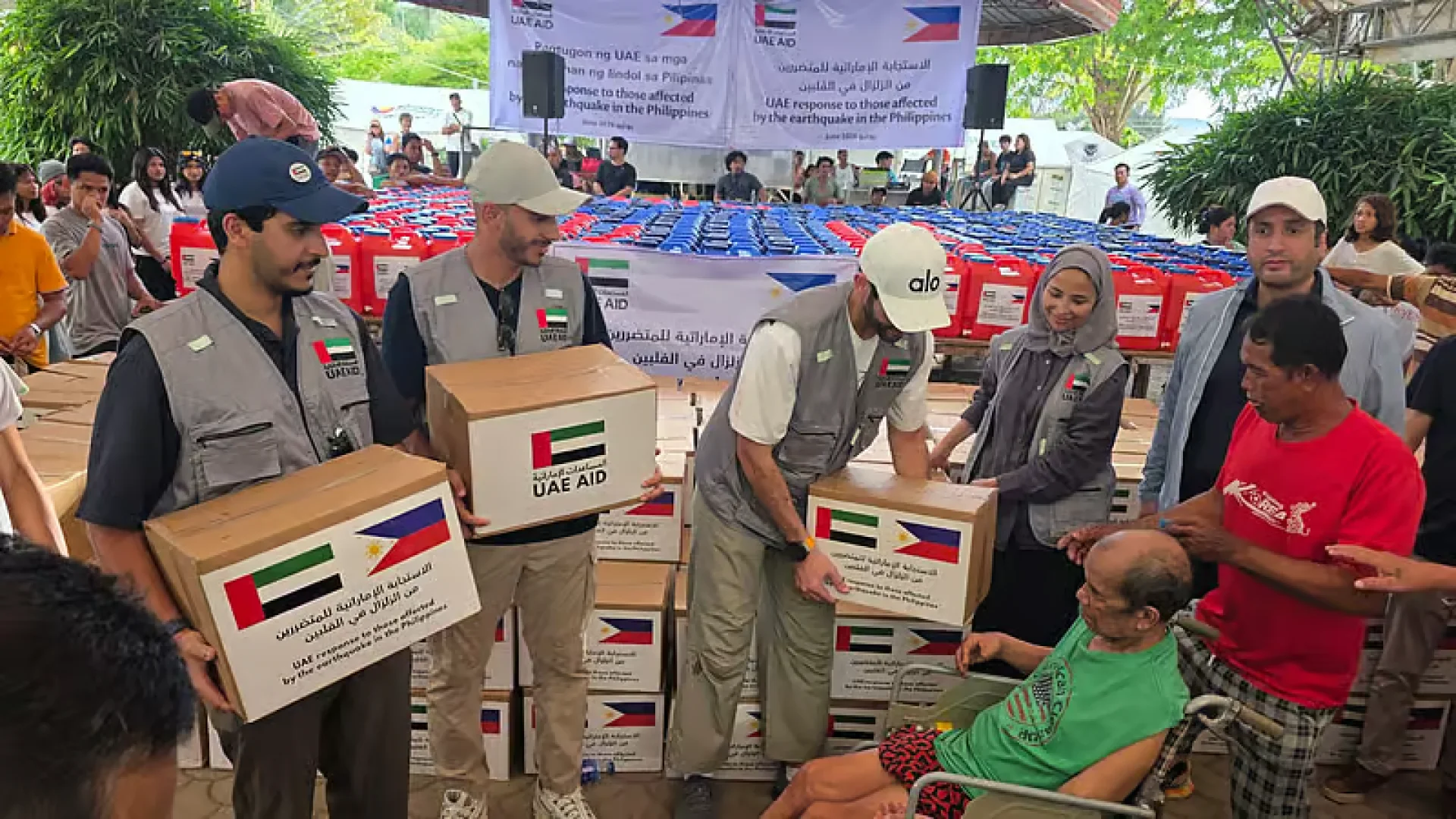

The ground is still restless, but the relief convoy didn’t wait: the UAE has delivered 20,000 food packs to a Philippine town hit hard by a powerful earthquake, even as strong aftershocks continued. The shipment is designed as immediate support for families grappling with disrupted supply lines and damaged homes, many sheltering in temporary conditions. On the distribution site, fear and focus share the same air—each tremor pauses the crowd, each carton restarts the day. In a place where routines cracked overnight, aid becomes tangible again: food on the table, time to breathe, and a clear message that help arrived.
The first thing you notice is the silence between the shakes.
Not a calm, peaceful silence—more like a held breath. A pause that feels too deliberate, as if the town is listening for the next movement under its feet. Then the ground gives a quick, sharp shrug. A few heads snap up. Someone mutters, “Aftershock.” And life, carefully, resumes.
In the middle of this uneasy rhythm, cardboard boxes stand stacked like a new kind of architecture—temporary, practical, quietly heroic. The UAE has delivered 20,000 food packs to an earthquake-hit town in the Philippines, pushing the shipment through even as strong aftershocks continued to ripple through the area. It’s the kind of detail that sounds like a headline until you’re here, watching a mother’s hands tighten around a package as if it were a railing on a stormy deck.
“Keep the line moving,” a local coordinator calls out. His voice tries to sound ordinary. Ordinary is the goal now.
Relief is not just something you feel; it’s something you can hear. The rip of packing tape. The thud of cartons meeting wooden pallets. The dry scrape of shoes on dusty concrete. A pen clicking as names are checked, counts confirmed, signatures pressed into paper that suddenly matters more than it ever did before.
The food packs—part of an emergency humanitarian response—are meant to bridge the gap when supply chains stutter and households lose their usual access to basic goods. Here, people don’t talk in press releases. They talk in meals.
“We can cook again,” an elderly woman says, half to herself, half to the air. She doesn’t embellish. She doesn’t need to. In a disaster zone, a simple sentence can land like a blessing.
No one is expecting luxury inside these boxes. They’re expecting the essentials that hold a day together: durable staples, items that can be portioned out, shared, stretched across a family. A few days of certainty in a week that has none.
Another tremor rolls through—short, insistent, like a warning tap on the shoulder. The line stops. For one second, the entire scene becomes a photograph: a father mid-step, a child’s fingers curled around a sleeve, a volunteer’s arms wrapped around a carton.
Then someone exhales loudly, almost theatrically. A few nervous laughs. “We’re okay,” a woman says, and the spell breaks. The line starts again.
This is what resilience looks like up close. Not speeches. Not slogans. Just movement—slow, steady movement—through uncertainty.
The UAE shipment is logistics on paper, but on the ground it becomes something else: reassurance in physical form. When the world has shifted, the mind clings to what can be counted. Boxes are countable. Rations are countable. Days of food—countable. And in that math, people find a thin but real kind of peace.
A teenage boy hoists a pack that nearly blocks his view. “I got it,” he says quickly when an older man reaches out to help. Pride is a stubborn flame; even earthquakes don’t put it out.
Nearby, an older resident points at a crack running up a wall like lightning trapped in concrete. “Our table was there,” he says, nodding toward the fracture, as if the memory is still sitting in the room. He looks down at his food pack. “At least we have this.”
The town feels caught between two clocks. The old one—the clock of regular life, with school runs and work shifts and dinner at a familiar hour—stopped the moment the quake hit. A new clock started immediately after, ticking in practical questions: Where do we sleep? Is the water safe? Who needs medicine? What’s left inside the house?
In that new time, food is more than sustenance. It’s structure. It’s the ability to plan the next step without the constant roar of hunger in the background.
Volunteers keep scanning the faces in line, looking for the elderly, for parents with small children, for anyone struggling to stand. “You, come forward,” one of them says, lifting a hand gently. The gesture is small, but it rearranges the day for a family. It creates order where the earth has been disorderly.
Disasters don’t only break buildings; they break habits. The simple act of making breakfast becomes a challenge when a kitchen is cracked, a stove is missing, a market is closed, a road is blocked. That’s why a box of basics can feel like a tool kit for normality.
You see people checking their packs with the seriousness of accountants: weighing, estimating, dividing. How many portions? How many days? Who gets what first? In crisis, adults become managers of survival. And children become experts at reading adult faces.
Between aftershocks, people talk about homes—what’s standing, what’s not, what might be repaired. They talk about sleeping outside, about the fear of going back indoors. And they talk about gratitude in a tone that is almost businesslike, because emotion is expensive when you need your energy for rebuilding.
Still, it’s there. In the way a woman touches the edge of a carton as if to confirm it’s real. In the way a man nods once, hard, when a volunteer tells him there will be distribution for others as well. In the way the crowd keeps coming back into motion after each shake.
Beyond the immediate humanitarian emergency, earthquakes trigger a rapid—and often lasting—reordering of local real estate markets. For homeowners, landlords, developers, and investors, the weeks after a major quake become a fast-moving cycle of damage assessment, temporary housing demand, reconstruction financing, and, ultimately, a repricing of risk.
1) Two markets overnight: safe vs. uncertain
After a quake, buyers and renters quickly split properties into categories: clearly safe, repairable, and unsafe. Values can diverge sharply even within the same neighborhood. Construction quality, maintenance history, soil conditions, and documented structural checks start to matter as much as location—sometimes more.
2) Surge in temporary accommodation demand
Displacement pushes demand toward short-term rentals and flexible housing solutions:
For ethical operators, this is a moment to deliver safe, fairly priced stock quickly—paired with transparent contracts and clear safety standards.
3) Reconstruction economics: costs, labor, timelines
Rebuilding often collides with higher material prices, labor shortages, and strained logistics. Investors must factor not only repair costs but downtime: How long until a unit is habitable, insurable, and rentable again? In many cases, time becomes the most expensive line item.
4) Risk management for owners
In seismically active regions, resilience is an asset. Practical steps include:
5) The long view: resilience premiums
Where reconstruction programs upgrade codes and enforcement, markets can develop a “resilience premium.” Newer buildings with verified seismic design, reliable utilities, and strong access to services often command higher occupancy and stronger pricing over time.
The UAE’s 20,000 food packs matter because they stabilize the present. But recovery also means stabilizing the built environment—so that the next aftershock doesn’t turn today’s survival into tomorrow’s displacement again.